
CCTV survey: $300–$750
Stands alone and is credited against the works by most operators. Without it nobody can price a liner honestly.
A cracked or root-damaged drain does not have to mean a trench through the garden. A resin liner is cured inside the existing pipe from an access point you already have, sealing every joint along the run, and the surface above is never touched.
Relining is a structural repair, not a cleaning method, and the distinction matters when you are comparing quotes. Jetting restores flow through a pipe that is still cracked. A liner restores the pipe.
That also means it is not always the answer. It cannot correct a run that has sagged or lost its fall, and it has nothing to line against where a section has collapsed. A camera survey separates those cases in about an hour, and the answer changes the cost by a multiple.
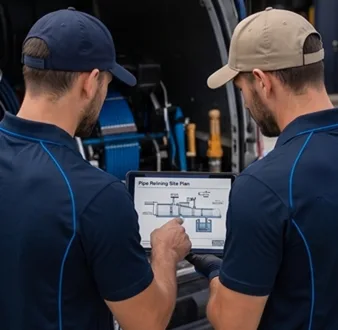
In a strip of tenancies the drainage is frequently shared, which means the fault is often not under the premises reporting it, and the party who pays is not always the party who called.
That is worth settling before the quote rather than after. Camera footage with distances marked from a known access point is what makes the conversation with a landlord or a neighbouring tenant short, because it shows exactly where the defect sits.
Caringbah (postcode 2229) spreads across the Sutherland Shire plateau between Woolooware Bay and Port Hacking, anchored by its station and the Kingsway shopping strip and bordered by Miranda, Taren Point and Caringbah South. Housing here spans a century of pipework, from original clay sewers to brand-new duplex drainage.
Ground near water holds more of it, sits lower and moves more through the seasons than ground further up. Pipework laid decades ago has been flexed by that movement for its whole life, and joints open a fraction at a time rather than failing all at once.
It is why faults here tend to arrive as a slow decline rather than a sudden break, and why a camera often finds a run that is uniformly tired instead of one obvious defect. That pattern suits a full-length liner rather than a patch.
On a clay line the barrel is usually fine. What has gone is the mortar or rubber ring at each joint, and there is one every few hundred millimetres, which is a great many small openings after sixty or eighty years in the ground.
The original cottages around the Kingsway and rail precinct still run early earthenware sewers whose worn joints crack, sag and catch waste.
That matters for the quote. You are not replacing a pipe, you are sealing a long series of joints, and a liner does the whole run at once rather than patching them one at a time.
Once is weather. Twice is a defect, and the second event is the point at which paying for a camera saves money rather than costing it.
What we are looking for is specific: a belly holding water, a joint that has opened, a section crushed by a vehicle crossing. Each has a different answer, and only one of them is relining. Knowing which you have is worth more than another clear.
Where the water table sits close to the pipe, every open joint is an entry point. The line runs fuller than it should year-round, silt comes in with the water, and the system behaves as though it is undersized when it is simply leaking inward.
Sealing the run changes that immediately, and it is one of the clearest before-and-after results relining produces. It is also the case most often missed, because nothing looks broken from the surface.
Stands alone and is credited against the works by most operators. Without it nobody can price a liner honestly.
The usual Sydney range for domestic sewer. Access and junction reinstatement are normally quoted separately.
One defect in an otherwise sound run. The proportionate answer on stable ground, and the wrong answer on a line with twenty tired joints.
Where the camera shows the same failure repeating along the length. Ends the problem rather than relocating it.
The honest comparison. Cheaper on an open lawn, rarely cheaper under a driveway, paving or a building.
Indicative Sydney ranges for 2026. Your job is quoted in writing after the camera survey. Figures here are indicative of the 2026 Sydney market rather than a quote from us, you get your own number as a fixed price before any work starts.

We find the fault, measure it from an access point, and check the fall is intact. That last check is what stops a liner being installed into a belly.
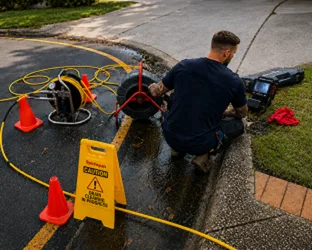
Per metre, with access and junction reinstatement itemised, and the excavation comparison alongside it so you can see both.
Clean, install, cure. One access point, one day for most homes, and no trench across the property.

Branches reopened, final footage, certificate and notification. Keep it with the property file, it is worth real money at sale.
Leave your details and a licensed plumber will call back to arrange the survey. No quote is given before someone has seen inside the pipe.
The questions that come up before every relining job, answered with real numbers.
Call for the fastest answer, or send the form and we will arrange a camera survey before anything is quoted.

Leave your details and our local Caringbah team will call you back fast.